
Why Surveillance Footage Disappears After a Houston Car Wreck — and How to Preserve It

Updated: Sep 4
In the immediate aftermath of a Houston car wreck — whether it’s a high-speed collision on the I-10 Katy Freeway or a blind-side hit in the Heights — there is a brief, critical window where the truth is perfectly preserved. Skid marks are fresh, the "black box" in your vehicle holds the final seconds of telemetry, and nearby surveillance cameras have the entire event recorded in high definition.
Then, the clock starts ticking.
At The Demerson Firm, PLLC, we often see clients who come to us weeks after an accident, confident that the "camera on the corner" will prove they weren't at fault. Unfortunately, by the time many victims realize they need that footage, it’s already gone. In the legal world, we call this the "decay of evidence," and in a city as fast-moving as Houston, it happens faster than you think.
Understanding why this evidence disappears — and how to stop the clock — is the difference between a successful recovery and a denied claim.
The 24-Hour Loop: Why Surveillance Footage is the First to Go
Most people assume that if a business has a security camera pointed at the street, that footage is stored indefinitely. This is a dangerous misconception.
Commercial surveillance systems are designed for loss prevention and security, not for archiving traffic accidents. To save on storage costs, most systems use "loop recording." This means the software is programmed to record over old footage once the hard drive reaches capacity.
In busy Houston retail corridors like Westheimer Road or Richmond Avenue, retention is often measured in days rather than weeks — some systems overwrite within 24 to 72 hours, though the window varies widely with the system, the storage installed, and how busy the location is. If you wait a week to contact a Houston car accident lawyer, the video of the other driver running a red light may already be gone, erased by a scheduler that has no idea your claim exists.
The TxDOT and City Camera Myth
Many drivers see cameras mounted on traffic signals and assume the City of Houston or TxDOT is recording their every move. In reality, many of these are live-feed only — used by traffic engineers to watch flow rather than to archive video. Where recordings do exist, retention periods are often short. Getting them means a request under the Texas Public Information Act, Tex. Gov't Code ch. 552, filed fast enough to beat the agency's retention schedule. The agency's response timeline is not built around your claim.
The Digital Witness: The Event Data Recorder (EDR)
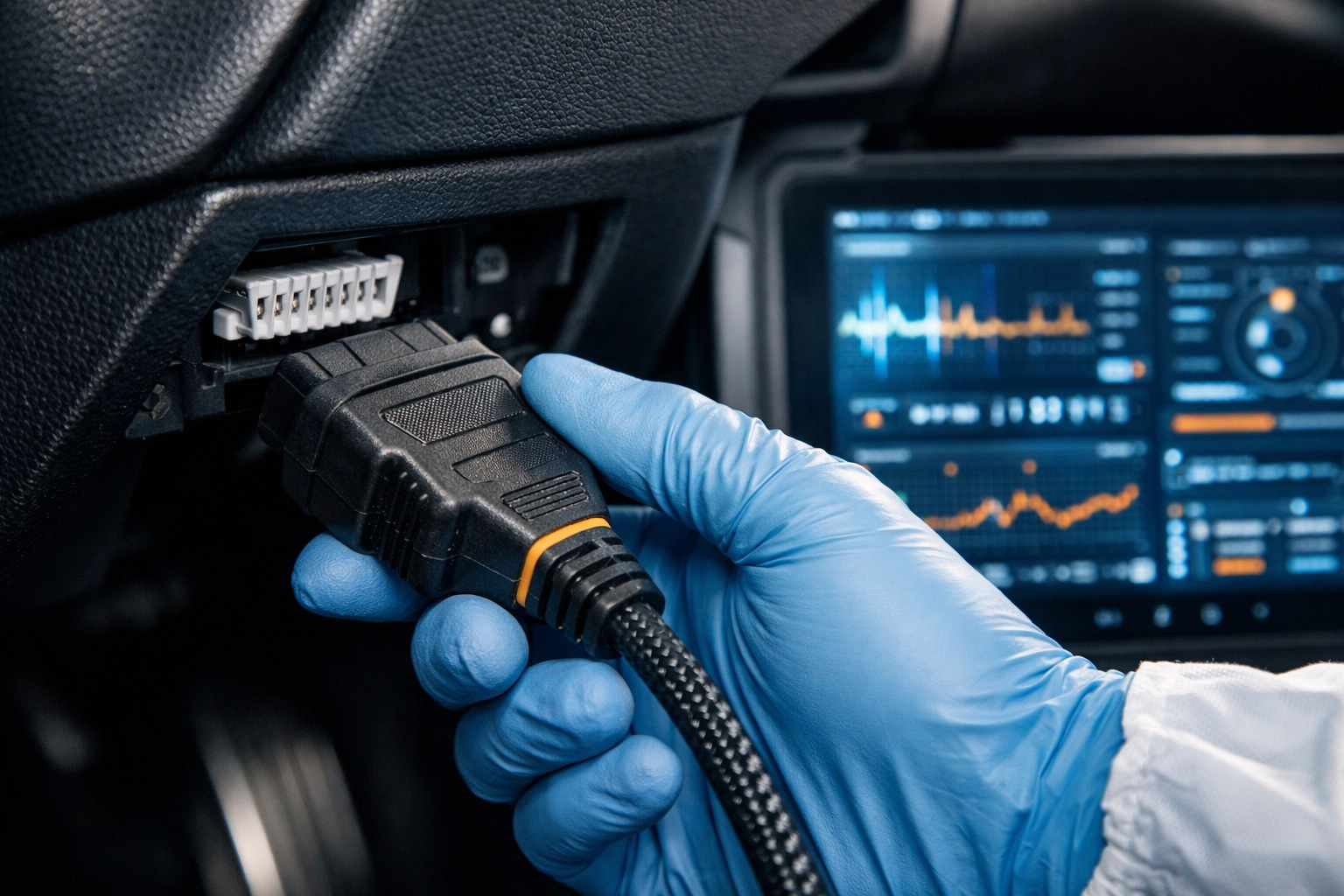
Every modern vehicle is equipped with what is colloquially known as a "Black Box." Officially termed the Event Data Recorder (EDR), this device captures technical vehicle information in the seconds leading up to, during, and after a crash.
The EDR records:
Vehicle speed
Brake application (or lack thereof)
Steering input
Force of impact
Seatbelt usage
This data is the "gold standard" of evidence because it doesn't lie and it doesn't forget. However, it is also highly volatile. If a car is totaled and sent to a salvage yard, the EDR can be lost forever. Even if the car is repaired, subsequent driving or diagnostic resets can sometimes overwrite the crash data.
At The Demerson Firm, PLLC we send a preservation letter early, asking insurers, repair shops, and salvage yards not to destroy or alter the vehicle before the data can be imaged. A preservation letter is a request, not a court order — its real value is that it puts the recipient on notice, which is exactly what the duty-to-preserve analysis turns on. For how these claims work generally, see our answers to common Texas motor vehicle claim questions.
The Fragility of Human Memory
While digital data disappears due to technology, witness testimony disappears due to biology. Human memory is not a video recording; it is a reconstruction.
In the minutes after a wreck on the 610 Loop, a witness might be 100% certain the other driver was on their phone. Two weeks later, after that witness has gone back to their busy life, their certainty fades. They begin to doubt what they saw. They might even be influenced by leading questions from an insurance adjuster looking to shift blame.
This is why on-the-scene witness statements matter. We work to lock in accounts through written statements or affidavits before the forgetting curve takes hold. Under Texas proportionate responsibility law, a claimant found more than 50% responsible recovers nothing, and any share at or below that reduces the recovery proportionally. Tex. Civ. Prac. & Rem. Code §§ 33.001, 33.012(a). A few percentage points of drift in a witness's account can move that number.
Spoliation of Evidence: The Legal Shield
When evidence disappears after a party knew or reasonably should have known that a claim was likely, the law calls it spoliation. The controlling framework in Texas is Brookshire Brothers, Ltd. v. Aldridge, 438 S.W.3d 9 (Tex. 2014). Under Brookshire Brothers, the trial court — not the jury — decides whether a party owed a duty to preserve the evidence, whether it breached that duty, how culpable it was, and what remedy fits. A jury instruction that the missing evidence would have been unfavorable sits at the severe end of that range: it requires a finding that the party acted with intent to conceal or destroy relevant evidence, or that a negligent breach irreparably deprived the other side of any meaningful ability to present a claim or defense.
That framework is why the duty-to-preserve question does so much of the work. You cannot simply say the footage is gone; you have to show the party owed a duty to keep it. That is why the first thing we do is send preservation letters to everyone who might hold something — the other driver, their employer if a commercial vehicle was involved, nearby businesses, and the insurance carriers. Brookshire Brothers also holds that evidence bearing solely on the spoliation itself generally stays away from the jury, so those letters do their work in front of the judge rather than the jury box.
Why Rapid Evidence Preservation is the Strategic Advantage
In a serious injury case, the insurance company isn't your friend. They are a multi-billion dollar corporation designed to minimize payouts. They have "Go Teams" of investigators who are often on the scene before the tow truck arrives. They are grabbing the evidence that helps them and ignoring the evidence that helps you.
To level the playing field, you need a strategy that prioritizes:
Immediate Scene Investigation: Taking high-quality photos of debris fields, skid marks, and final rest positions.
Canvassing for Video: Physically visiting every house and business within a two-block radius to identify Ring doorbells and private security systems.
Securing the Vehicle: Ensuring your car isn't sold for scrap before the EDR data is imaged.
Waiting even a few days can mean the permanent loss of the evidence that would have settled the liability question. Meanwhile the carrier is already working, which is why we tell clients to be careful about giving a recorded statement before the evidence picture is complete.

The Deadlines Running Behind All of This
Evidence preservation runs on one clock; the claim itself runs on another. In Texas, suit for personal injury generally must be brought not later than two years after the day the cause of action accrues. Tex. Civ. Prac. & Rem. Code § 16.003(a). A claim for injury resulting in death runs two years from the date of death. § 16.003(b). Limitations are tolled while the injured person is under 18. § 16.001.
If a governmental unit is a potential defendant — a city vehicle, a county truck, a roadway or signal condition within the Tort Claims Act — notice comes due far sooner than suit. A governmental unit is entitled to written notice of the claim not later than six months after the incident. Tex. Civ. Prac. & Rem. Code § 101.101(a). Section 101.101(b) ratifies shorter periods set by city charter, and the City of Houston's charter (Art. IX, § 11) requires verified written notice within 90 days. Note the distinction: asking a city for its camera footage is a records request under Chapter 552; putting that city on notice that you intend to hold it liable is a separate, deadline-bound step.
FAQs: Houston Evidence Preservation
Q: Can I get the footage from a Ring doorbell myself? A: You can ask, but homeowners are not legally required to give it to you. Often, they feel more comfortable providing it to a law firm or an investigator. If they refuse, we can use a subpoena once a lawsuit is filed — but only if the footage hasn't already been deleted.
Q: Does the police report count as "evidence"? A: A crash report is hearsay, and whether any of it reaches a jury is litigated case by case. Texas Rule of Evidence 803(8) allows a public record setting out factual findings from a legally authorized investigation to be admitted in a civil case unless the opponent shows the source of information or the circumstances indicate a lack of trustworthiness — but an officer's opinion on fault, and statements bystanders gave the officer, raise separate hearsay problems. Reports also contain errors. Either way, do not count on an officer to preserve video or black box data for you; the job at the scene is to clear the road and decide whether an offense occurred, not to build your civil case. A: In Texas, a police report is often considered hearsay and may not be fully admissible in court. Furthermore, police reports frequently contain errors. You cannot rely on a police officer to preserve the video or black box data for you; their job is to clear the road and determine if a crime was committed, not to build your civil case.
Q: What if the other driver deleted their dashcam footage? A: A preservation letter helps show they were on notice, which matters to the duty-to-preserve question. A remedy is not automatic, though. Under Brookshire Brothers the trial court decides, outside the jury's presence, whether a duty existed, whether it was breached, and whether the conduct was intentional or so prejudicial that no lesser sanction will do. It is a real tool, not a guaranteed outcome. A: If we sent a preservation letter and they deleted it anyway, we can pursue sanctions for spoliation. This is one of the strongest tactical advantages we have in litigation.
The Demerson Firm, PLLC Advantage
At The Demerson Firm, PLLC, we don't just "handle" cases; we build them from the ground up with forensic precision. We understand that in Houston, evidence is a disappearing commodity. Our approach is characterized by aggressive, disciplined advocacy designed to capture the truth before it's overwritten.
If you’ve been involved in a wreck, don’t assume the evidence will be there tomorrow. The "secrets" of evidence preservation are only secrets until you know how the system works. Once you know, you realize that speed is the only thing that matters.
Contact The Demerson Firm, PLLC for a review of your claim. We know the common places this evidence lives, and we move quickly to preserve what can still be preserved.

The Demerson Firm, PLLC · 8323 SW Freeway, Ste. 415, Houston, TX 77074 · (346) 344-2007 · chris.demerson@demersonlegal.com
This article is general information about Texas law. It is not legal advice, and reading it does not create an attorney-client relationship. Every case turns on its own facts, and prior results do not guarantee a similar outcome in any other matter.
Comments