
Uninsured Motorist Claims in Texas: What to Do After a Houston Hit-and-Run

Updated: Sep 4
Houston runs on its highways, and Texas consistently ranks among the states with the highest share of uninsured drivers. That means a meaningful number of the vehicles around you on any given commute carry no liability coverage at all.
The usual assumption after a crash is that the at-fault driver's insurance pays. So what happens when that driver has no policy — or leaves the scene entirely?
This guide covers how Uninsured and Underinsured Motorist coverage works in Texas, the physical-contact rule that trips up hit-and-run claims, and one feature of Texas UIM law that surprises nearly everyone — including people who have paid premiums for decades.
Understanding UM/UIM Coverage in Texas
Texas insurers are required to offer this coverage. Under Tex. Ins. Code § 1952.101, an insurer may not deliver an automobile liability policy unless UM/UIM coverage is included — unless the named insured rejects it in writing. Check your declarations page before assuming you do not have it; many Texans carry it without realizing.
The coverage is designed to stand in for the at-fault driver. If you are hit by someone with no insurance (uninsured) or with limits too low to cover your damages (underinsured), your own policy is the source of recovery. It reaches:
Bodily Injury: Medical expenses, lost wages and earning capacity, physical pain, mental anguish, and impairment.
Property Damage: Repairs to your vehicle, subject to a $250 deductible under Tex. Ins. Code § 1952.105(b) — usually lower than a standard collision deductible.
In a car accident where the driver flees, the unidentified driver is treated as uninsured. Recovering, however, is not automatic — for two very different reasons covered below.
The Part Nobody Tells You: A UIM Carrier Owes Nothing Until You Get a Judgment
This is the single most important thing to understand about Texas UM/UIM claims, and it is the opposite of what most people expect.
In Brainard v. Trinity Universal Insurance Co., 216 S.W.3d 809 (Tex. 2006), the Texas Supreme Court held that a UIM insurer has no contractual duty to pay benefits until the insured obtains a judgment establishing the other motorist's liability and underinsured status. In practical terms, that means three things:
Demanding your policy limits does not, by itself, obligate your insurer to pay anything.
Neither a settlement with the at-fault driver nor that driver's admission of fault establishes UIM coverage.
Your carrier can decline to pay without acting in bad faith, because until liability and damages are established there is nothing yet owed.
So UM/UIM coverage is genuinely valuable — often it is the only realistic source of recovery — but it is not a fund that pays out on request. Getting to it usually requires litigating the underlying claim. That is why people who try to handle a UIM claim alone frequently stall for months and cannot understand why their own insurer will not move.
The Hit-and-Run Dilemma: The Physical Contact Rule
The second obstacle is specific to hit-and-run claims. Tex. Ins. Code § 1952.104(3) generally requires actual physical contact between the unidentified vehicle and the insured or the insured's vehicle for UM coverage to apply. The rule exists to prevent unverifiable "phantom vehicle" claims.
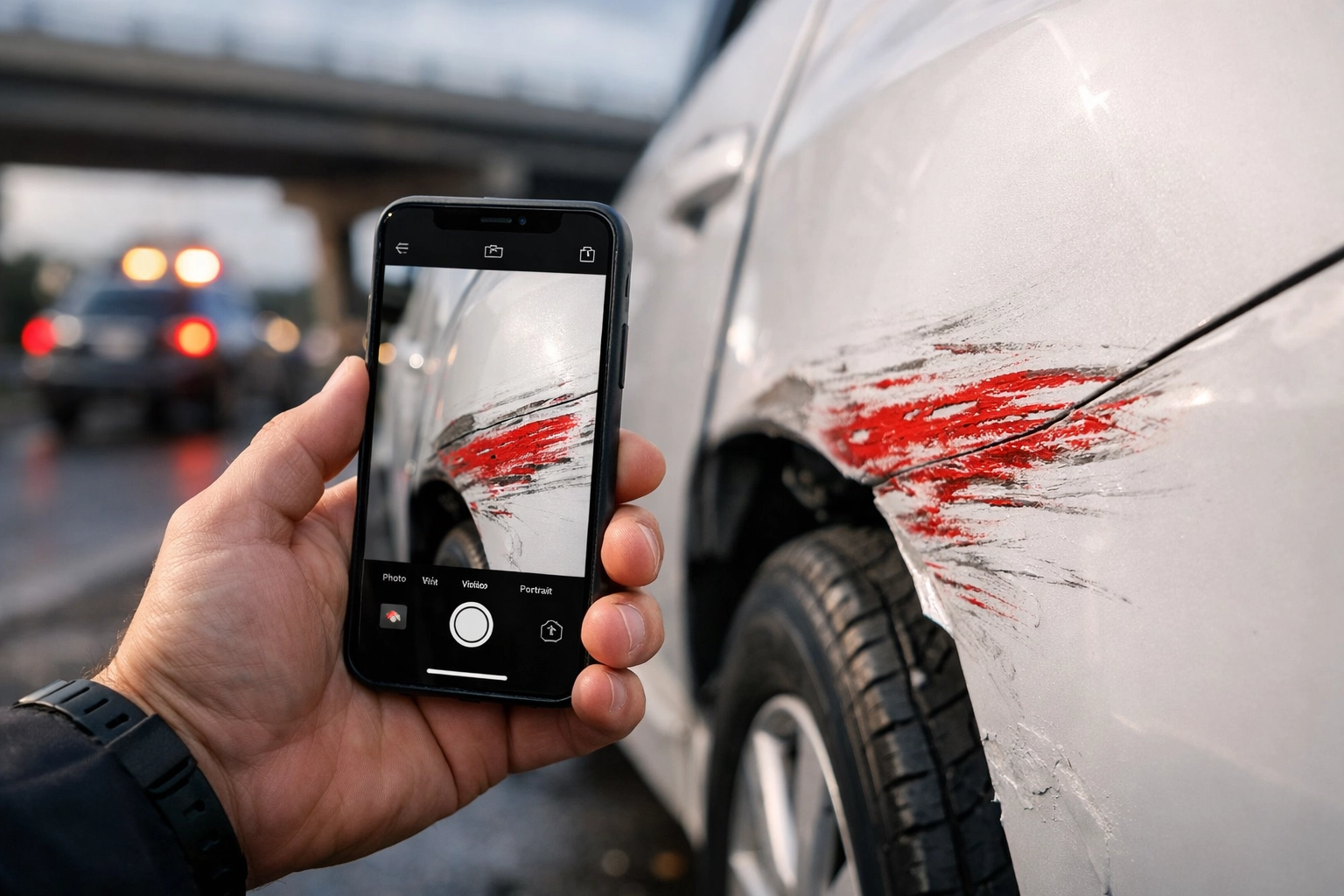
The practical consequence is harsh. If a driver cuts you off and you swerve into a barrier without ever being touched, your carrier will likely deny the UM claim for lack of contact — the so-called miss-and-run. Physical evidence such as paint transfer or impact marks is therefore critical, and if you believe there was contact, say so clearly to the responding officer and photograph the point of impact before the vehicle is repaired. Whether a particular set of facts satisfies the requirement is exactly the kind of question worth putting to a lawyer rather than conceding to an adjuster.
Immediate Post-Crash Protocol
Because you are bringing a claim against your own insurer, that insurer will scrutinize whether an unidentified driver existed at all. Treat the claim with the same care you would give a third-party carrier.
Contact the Police Immediately: A hit-and-run claim is very difficult without a crash report. Call 911 for emergencies, or HPD non-emergency at 713-884-3131. Make sure the officer records that the other driver fled.
Document Contact and Paint Transfer: Photograph the damage in high resolution and look specifically for paint from the fleeing vehicle. Given the physical-contact rule, this is often the evidence the whole claim turns on.
Canvass for Surveillance: Check nearby gas stations, storefronts, and homes with doorbell cameras. Private systems commonly overwrite footage within days, so the request has to go out quickly. We send preservation letters as soon as we are retained.
Identify Witnesses: Anyone who saw the impact can confirm the fleeing vehicle existed — which matters enormously when your own carrier is questioning that.
Two Different Clocks: Your Policy and the Statute
The Texas statute of limitations for personal injury is generally two years under Tex. Civ. Prac. & Rem. Code § 16.003(a). Your policy runs on a separate and usually much shorter clock: most auto policies require notice of a claim promptly, or "as soon as practicable." The exact wording is in your policy, not in a statute — read it, or have someone read it for you.
Late notice gives a carrier an argument that the delay prejudiced its ability to investigate. Do not wait for your injuries to resolve or for police to identify the driver before notifying your own insurer.
Why Suing the Uninsured Driver Is Usually a Dead End
Clients reasonably ask whether we can find the driver and sue them personally. Sometimes we can find them. Collecting is the harder problem.
Texas has unusually strong debtor protections. The homestead exemption — found in Tex. Const. art. XVI, §§ 50–51 and Chapter 41 of the Property Code — shields a primary residence from most creditors, and Chapter 42 protects a substantial amount of personal property. A driver with no insurance frequently has no reachable assets either. A judgment against someone with nothing to collect is a piece of paper.
That is why UM/UIM coverage matters so much: in most hit-and-run and uninsured-driver cases it is the only realistic source of recovery. But as explained above, it is not a guarantee of payment — under Brainard the carrier owes nothing until liability and damages are established. It is a source of recovery you have to establish, not a fund that pays on demand.

Why a UM Claim Turns Adversarial
A common and understandable mistake is assuming your own insurer is on your side in a UM claim. Once you file one, your carrier effectively occupies the position of the person who hit you. Its financial interest is now opposed to yours.
Expect these arguments:
Comparative Fault: That you were partly responsible. Under Tex. Civ. Prac. & Rem. Code § 33.001, a share of responsibility greater than 50% bars recovery entirely; at 50% or less it reduces your recovery proportionally.
Pre-existing Conditions: A review of your medical history to argue the injuries predate the crash.
Recorded Statements: An early, informal-sounding statement — often hoping you will describe the crash in a way that concedes no physical contact, or minimize injuries before they are diagnosed.
How We Prepare a UM/UIM Case
Because Brainard means a UIM case is built to be proved rather than negotiated, we prepare these files the way we would prepare for trial from the beginning. Depending on the case that includes:
Accident Reconstruction: To establish how the impact occurred — and, in a hit-and-run, that contact happened at all.
Medical Experts: To connect diagnostic imaging to the mechanism of injury and rebut a pre-existing-condition defense.
Vocational and Economic Experts: Where an injury prevents a return to your work, to establish lost earning capacity on evidence.

Frequently Asked Questions
Will my premium go up if I file a UM claim?
This is worth being careful about, because a lot of sites state it too confidently. Texas law does place some limits on rating consequences — for example, Tex. Ins. Code § 1953.051 restricts using a mere consumer inquiry or a claim that was not paid or payable as a rating factor. But there is no blanket prohibition on premium increases following a paid not-at-fault claim, and § 551.107 addresses circumstances in which an insurer may surcharge on renewal. What actually happens depends on your carrier's filed rating rules and your claims history. If this matters to your decision, ask your agent for the specific rating consequence in writing before you file.
What if I was a pedestrian or cyclist hit by a car?
UM/UIM coverage on your auto policy commonly follows you, not only your vehicle. If you are struck as a pedestrian or cyclist by an uninsured or fleeing driver, your own auto policy's UM provision may respond. Coverage depends on your policy language, so have it reviewed rather than assumed.
Can I recover pain and suffering under UM coverage?
Yes. UM bodily injury coverage reaches the same categories of damages you could recover from a liability carrier, including physical pain, mental anguish, impairment, and loss of consortium. Remember the Brainard point above, though — being entitled to those categories is not the same as the carrier owing them before liability and damages are established.
Is there a deductible for UM claims?
For property damage, Tex. Ins. Code § 1952.105(b) provides for a $250 deductible — typically lower than a standard collision deductible. Bodily injury coverage does not carry that deductible.
Talk to a Houston Uninsured Motorist Lawyer
If you have been hit by an uninsured driver or someone who fled, the two things that matter most are moving quickly on the evidence and understanding that your own carrier is not going to simply write a check. You paid for this coverage; making it produce a recovery is a legal process, not a claims-form exercise.
The Demerson Firm, PLLC handles UM and UIM claims with that reality built into the plan from day one.
Call (346) 344-2007 or contact us for a free personal injury consultation. The Demerson Firm, PLLC, 8323 SW Freeway, Ste. 415, Houston, TX 77074. We handle these matters in Harris, Fort Bend, Montgomery, Brazoria, and Galveston Counties.
This article is provided for general informational purposes only and is not legal advice. Reading it does not create an attorney-client relationship with The Demerson Firm, PLLC. Texas law changes, and UM/UIM coverage in particular turns on the specific language of your own policy. Speak with a licensed Texas attorney about your situation before making decisions about a claim.
Comments