
How to Challenge an Inaccurate Rear-End Collision Report in Texas: A 5-Step Guide

Updated: Sep 4
You’re sitting at a red light on the West Loop, minding your own business, when — BAM — someone slams into your rear bumper. You’re dazed, your neck is stiff, and the police arrive to sort it out. You assume the truth is obvious: you were stopped, and they hit you.
But a week later, you get the Texas Peace Officer’s Crash Report (CR-3), and your jaw drops. The officer marked you as a contributing factor. Maybe they claim you made a sudden stop, or your brake lights were out. Suddenly, the insurance company is calling, acting like the case is closed because "the report says it's your fault."
Here is the hard part: a police report is not the final word, and it is also not automatically excluded. A crash report is hearsay, but Texas Rule of Evidence 803(8) allows a public record setting out factual findings from a legally authorized investigation to be admitted in a civil case unless the opponent shows the source of information or the circumstances indicate a lack of trustworthiness. Courts commonly admit the objective portions while excluding an officer's opinion on fault and statements bystanders gave the officer. Reports are also frequently wrong. Insurance adjusters, meanwhile, treat them as gospel when it suits them.A police report is not the final word. In Texas, police reports are often inadmissible as hearsay in a personal injury trial, and they are frequently riddled with errors. However, insurance adjusters treat them like the Holy Grail to deny claims.
If you want to protect your recovery, you have to push back. As a Houston car accident lawyer, I have seen a wrong report derail a legitimate claim. Here is a five-step approach to challenging an inaccurate rear-end collision report in Texas — see also our checklist for what to do after a Houston car accident.
1. Obtain and Deconstruct the CR-3 Report Immediately
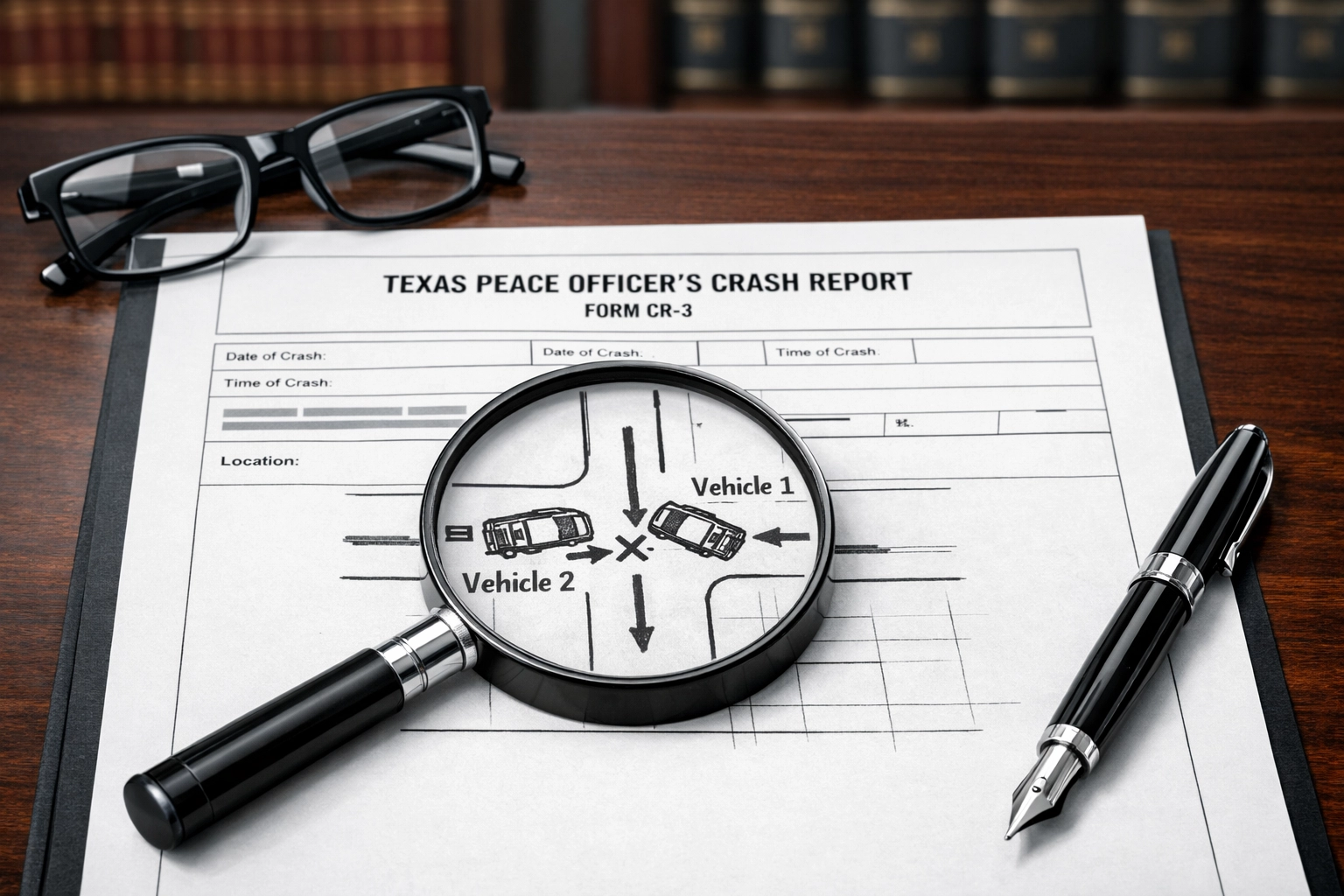
In Texas the official crash report is the Texas Peace Officer's Crash Report, form CR-3. TxDOT is the custodian of crash records, and you buy a copy through its Crash Report Online Purchase System at cris.txdot.gov. TxDOT's posted cost is $6 for a regular copy and $8 for a certified copy, plus a processing surcharge. Tex. Transp. Code § 550.065 governs who may obtain a report — that includes anyone involved in the crash and their authorized representative — and § 550.062 requires the investigating officer to submit the report to TxDOT not later than the tenth day after a crash involving injury, death, or apparent property damage of $1,000 or more. Note that the older Driver's Crash Report (CR-2) is dead law: SB 312 (85th Leg.) retired it effective September 1, 2017, retention expired January 1, 2019, and TxDOT destroys any CR-2 sent to it.
Once you have it, do not just skim. Look at the Contributing Factors field. Texas officers select from a coded list of contributing factors and record one or more for each unit involved. Common entries in a rear-end case include:
Failed to control speed — the entry most often recorded against the rear driver. Failed to Control Speed (The most common code for the rear driver).
Changed lane when unsafe. Changed Lanes When Unsafe.
Disregarded a stop sign or signal. Failed to Stop for Signal/Sign.
If the officer recorded a factor next to your name suggesting you stopped suddenly or failed to signal, that is where the blame is being shifted. Check the diagram too. Does it reflect the actual lane positions? Wrong street names, wrong direction of travel, wrong vehicle information — these plain factual errors are the easiest to get corrected.
2. Secure Objective "Silent Witnesses" (Digital Evidence)
The police officer usually arrives after the crash. They are piecing together a puzzle based on what the drivers said at the scene. If the other driver was more "persuasive" or if you were being loaded into an ambulance and couldn't tell your side, the report will be biased.
To win, you need objective proof that doesn't rely on memory.
Dashcam Footage: This is the "gold standard." If you have a dashcam that shows you were legally stopped before the impact, the police report’s opinion becomes irrelevant.
Surveillance Video: Houston is covered in cameras. Check nearby gas stations, storefronts, and Ring doorbells. Retention is often measured in days — some systems overwrite within 24 to 72 hours, and the window varies widely — so a written preservation request needs to go out immediately. Houston is covered in cameras. Check nearby gas stations, storefronts, or Ring doorbells. Warning: Most businesses loop their footage every 24 to 72 hours. You must act immediately to secure this.
Event Data Recorders (EDR): Modern cars have "Black Boxes." These records can prove your speed, braking, and steering at the moment of impact.
Presenting this data to the insurance company moves you from asserting the officer was wrong to showing it. For the broader approach, see our guide to challenging an inaccurate police report.
3. Identify and Neutralize Witness Bias
Sometimes the police report includes statements from "witnesses" who didn't actually see the impact, or worse, friends of the other driver.
In Texas, we look for "disinterested witnesses": people who have no "skin in the game." If the police report missed a witness who stopped to help, we need to find them. Their testimony can clarify if the other driver was distracted by a phone or if they were speeding excessively before the rear-end collision.
When you work with a legal team, we often canvas the area or use private investigators to find people the police missed in the rush of clearing the scene. A single statement from a neutral bystander can flip a liability determination overnight.

4. Request a Formal Supplement (Fact vs. Opinion)
There are two types of errors on a Texas crash report: Factual Errors and Judgment Errors.
Factual Errors: Wrong date, wrong VIN, wrong insurance info, or wrong street. You can usually get these corrected by calling the officer, providing the correct documentation, and politely asking for an amendment.
Judgment Errors: The officer’s opinion that you contributed to the crash.
Most officers will not change their "opinion" just because you asked. However, you have the right to submit a Supplemental Statement. At The Demerson Firm, PLLC, we help clients craft these statements so they become a permanent part of the accident file. While the officer’s original note stays there, your detailed, evidence-backed rebuttal is right next to it, forcing the insurance adjuster to acknowledge a dispute exists.
One more thing worth knowing: TxDOT is the custodian of the crash report only. Dash camera video, field notes, and scene photographs are not part of TxDOT's file and must be requested from the investigating agency itself. And if a judgment error stands unchallenged, the carrier will lean on Texas proportionate responsibility law to argue your share should be higher.
5. Work the Proportionate Responsibility Numbers
Texas follows a modified comparative negligence system, and this is where the challenge actually pays off. Modified Comparative Fault system. This is the most important part of your challenge.
Under Tex. Civ. Prac. & Rem. Code § 33.001, a claimant may not recover damages if his percentage of responsibility is greater than 50 percent. At or below that line, the court reduces the damages by your percentage instead of barring them. § 33.012(a). Important: a police report does not assign these percentages — the trier of fact does, § 33.003(a) — but an unchallenged report is the document a carrier will use to argue for a number that puts you over the line.50% or less at fault. If the police report says you are 10% at fault for "faulty brake lights" and the other driver is 90% at fault for speeding, you can still win. However, if the report flips that and says you are 51% at fault, you are barred from recovery.
That is why the report gets challenged rather than accepted. By developing the other driver's violations and the objective data, the argument moves toward a lower share for you. Where your percentage lands is decided on the evidence in your specific case, and no outcome can be promised.
For more on how these claims work, see our answers to common Texas motor vehicle claim questions.
Common Myths About Rear-End Accident Reports
"The Police Report is the Final Law"
Not quite. An officer is a witness, but rarely an eyewitness to the impact — the report is a reconstruction built from statements and physical evidence. Whether any of it reaches a jury is litigated case by case under Texas Rule of Evidence 803(8), and the officer's opinion on fault and bystander statements inside the report raise their own hearsay problems. What is true is that the report is evidence to be tested, not a verdict. A police officer is a witness, but they are rarely an eye-witness. Their report is a summary of hearsay and physical evidence. In many Texas courts, the report itself isn't even allowed to be shown to the jury because it’s considered "hearsay."
"I Can't Sue if the Report Says I'm at Fault"
False as a matter of law. A report's fault notation is not a legal determination, and accident reconstruction, EDR data, and video can contradict it. Whether that works in your case depends entirely on the facts and the evidence available — prior results do not guarantee a similar outcome in any other matter. We regularly win cases where the initial police report was against our client. By using accident reconstruction experts and forensic evidence, we can prove the officer's initial assessment was flawed.
"I Should Wait for the Insurance Company to Investigate"
Dangerous. The insurance company’s "investigation" is designed to find reasons not to pay you. They will take your recorded statement and look for any contradiction to the police report to use against you. This is why Texas lawyers advise against recorded statements without counsel.
Frequently Asked Questions
How long do I have to challenge a police report in Texas?
While there isn't a strict statutory deadline to request a correction, you should do it within days or weeks. The longer you wait, the less likely an officer is to remember the scene or be willing to file a supplement.
Can I change the report if the officer didn't issue a ticket?
Yes. Just because no one was cited doesn't mean no one was at fault. Fault for a civil injury claim is different from criminal guilt.
What if the other driver lied to the police?
This is common. We look for inconsistencies between their statement and the physical damage to the vehicles. Physics doesn't lie, even if drivers do.
Why You Need Strategic Advocacy
Challenging a state document is uphill work. You are pushing against an officer's written conclusion, a carrier with every incentive to keep it, and a set of Texas statutes that turn on percentages.
At The Demerson Firm, PLLC we do not simply accept the crash report as fact. We investigate the scene, look at the black box data, and press adjusters who want to hide behind a flawed CR-3. If the paperwork in your Houston wreck is working against you, that is a problem worth addressing directly rather than hoping it resolves itself.The Demerson Firm, PLLC, we don't just "take" the police report as fact. We investigate the scene, analyze the "black box" data, and push back against adjusters who try to hide behind a flawed CR-3. If you’ve been involved in a Houston freeway wreck and the paperwork is working against you, you need a disciplined, strategic approach to clear your name and secure your recovery.
Don't let a mistake on a piece of paper cost you your financial future. Whether you are dealing with delayed injuries or total vehicle loss, the right legal strategy can flip the script.
Do Not Let the Report Fight Eat Your Deadline
There is no strict statutory deadline for asking an officer to supplement a report, but the claim itself has one. In Texas, suit for personal injury generally must be brought not later than two years after the day the cause of action accrues. Tex. Civ. Prac. & Rem. Code § 16.003(a). If a governmental unit may be liable, written notice is due to that unit not later than six months after the incident, § 101.101(a), and § 101.101(b) ratifies shorter city-charter periods — the City of Houston's charter (Art. IX, § 11) requires verified written notice within 90 days. Arguing with an adjuster does not pause any of it.
Contact The Demerson Firm, PLLC for a careful review of your accident report and a straight assessment of where your claim stands. Consultations for personal injury matters are free.
The Demerson Firm, PLLC · 8323 SW Freeway, Ste. 415, Houston, TX 77074 · (346) 344-2007 · chris.demerson@demersonlegal.com
This article is general information about Texas law. It is not legal advice, and reading it does not create an attorney-client relationship. Every case turns on its own facts, and prior results do not guarantee a similar outcome in any other matter.
Comments