
Pulled Over in Texas: What Your Rights Actually Look Like During a Traffic Stop

Updated: Sep 4
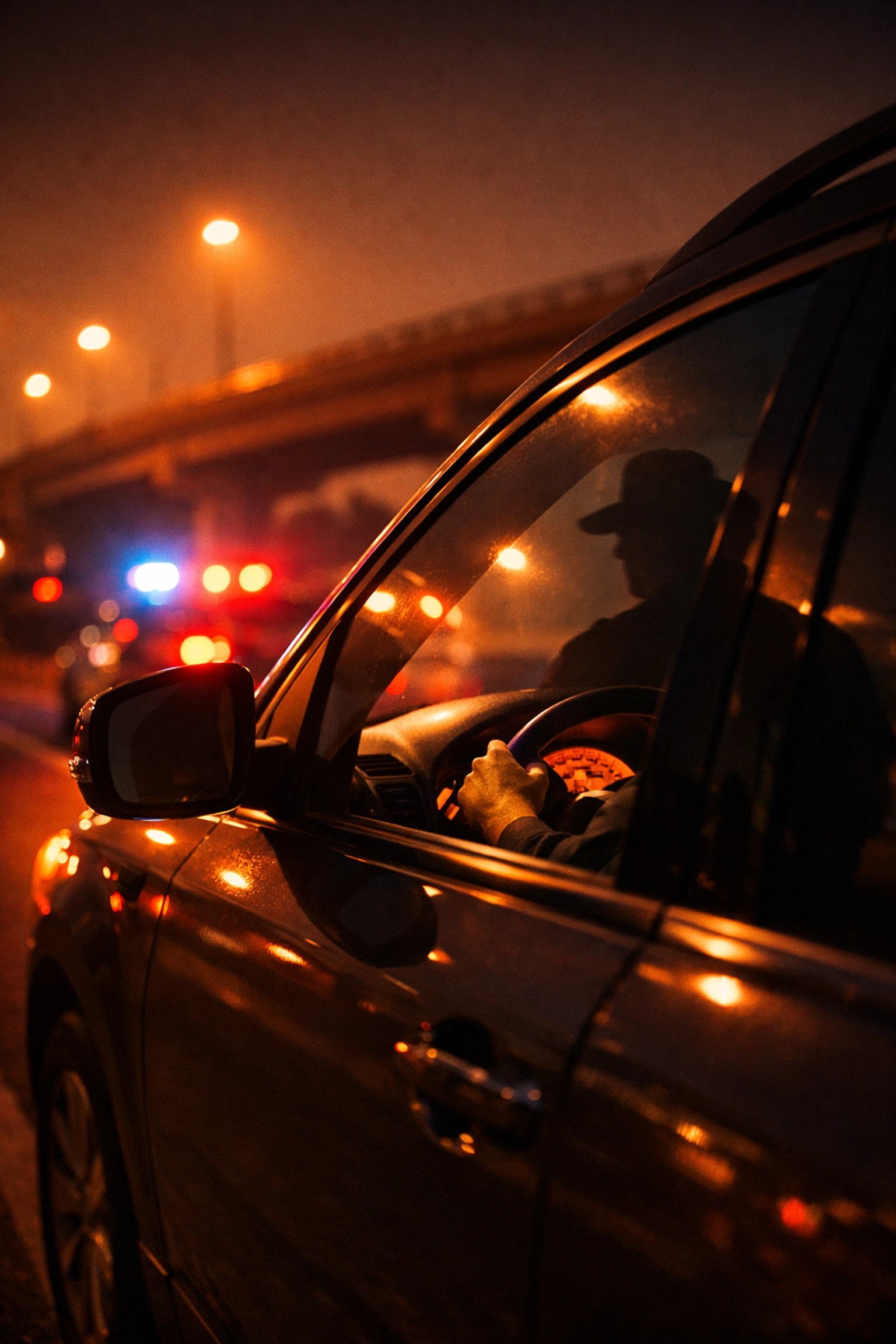
The flashing lights in your rearview mirror on I-10 or the 610 Loop produce an immediate physical response — heart rate up, palms damp, a sense of dread. For most Texans the fear is not really about the ticket. It is not knowing where the line is between what an officer can require and what you can decline.
A traffic stop is a seizure under the Fourth Amendment. Knowing the boundaries of that seizure is the difference between protecting your record and handing the State the evidence it needs. This article covers what Texas law actually requires of you during a stop — and, just as important, what it does not.
The Duty to Identify vs. The Right to Silence
Your obligations at the window are narrow. A driver must display a driver's license on demand under Tex. Transp. Code § 521.025, and must provide evidence of financial responsibility — proof of insurance — under § 601.053. Officers routinely ask for registration as well, and handing it over is ordinarily the path of least friction.
Beyond those documents, your obligation to assist the officer's investigation effectively ends. You are not required to explain where you have been, where you are going, or what you have had to drink.
Invoking the Fifth Amendment
The most common mistake drivers make is trying to talk their way out of a ticket. "Do you know how fast you were going?" and "Where are you coming from tonight?" are not conversation — they are questions designed to produce admissions that appear in a report.
Silence should be invoked out loud rather than simply performed. Say plainly: "I am going to remain silent, and I want a lawyer." Saying it matters: courts have treated simply going quiet, without invoking, differently from an express invocation.
Be realistic about what invoking accomplishes at the roadside. The Miranda right to counsel attaches to custodial interrogation, and an ordinary traffic stop is generally a temporary detention rather than custody. So invoking does not necessarily create a legal wall that stops all questioning on the spot — what it does is make your position unambiguous, and preserve the argument if the encounter later becomes custodial. Roadside admissions are frequently the strongest evidence the State has in a criminal case. Not producing them is the point.
The Fourth Amendment: Refusing Consent to Search
Consent is the most misunderstood part of a Texas traffic stop. Many drivers reason that if they have nothing to hide, letting the officer look proves it. That reasoning costs people cases.
The Power of "No"
An officer needs no warrant and no probable cause if you give permission. The moment you say yes, you have waived the objection — and you have no control over what turns up, whether it is a forgotten prescription bottle or something a passenger left in your car.
If an officer asks whether you mind if they take a look, the answer is a polite, firm: "I do not consent to any searches of my person, property, or vehicle." Declining is not evidence of guilt and is not grounds to arrest you.
What Refusing Consent Actually Does — and Doesn't
Here is the part a lot of online advice gets wrong. Refusing consent does not mean the officer now needs a warrant, and it is not true that they can only proceed on probable cause. It means they need some other lawful basis, and courts recognize several that require no warrant at all:
The automobile exception: probable cause to believe the vehicle contains evidence of a crime permits a warrantless search of it. Probable cause is a higher bar than the reasonable suspicion needed to make the stop, and it takes specific articulable facts rather than a hunch.
Search incident to a lawful arrest, within the limits the case law sets.
A protective search of the passenger compartment where the officer reasonably believes a weapon is present.
Plain view — an officer lawfully positioned may seize evidence sitting in open sight.
An inventory search after a lawful impoundment, conducted under standardized procedure.
Genuine exigent circumstances — a true emergency, not mere inconvenience.
None of that makes refusing pointless — it makes refusing essential. When you decline, the officer must rely on one of those grounds, and whether the ground genuinely existed is exactly what a motion to suppress litigates. Consent forecloses that argument before it starts. And while an officer cannot use a speeding stop as a pretext to go through your glove box on a hunch, the way you challenge an unlawful search is in a courtroom afterward, not on the roadside. Do not physically interfere.
When You Must Comply
You may stay silent and refuse searches. Physical commands are different — refusing those risks charges for interfering with public duties or resisting.
Exit Orders
Under Pennsylvania v. Mimms, an officer may order a driver out of the vehicle during a lawful stop for officer safety. You cannot refuse that. Step out calmly, keep your hands visible — and you can remain silent after you do.
The Terry Frisk
With reasonable suspicion that you are armed and dangerous, an officer may pat down your outer clothing. This is a limited search for weapons, not a search for drugs. A frisk does not depend on your consent, so objecting will not stop it — but stating clearly that you do not consent keeps the record clean about what you did and did not agree to, which can matter later in a criminal defense proceeding. Do not pull away or physically resist.
The DWI Investigation: Field Tests and Implied Consent
Houston DWI enforcement is aggressive. If an officer suspects impairment, the stop turns into a DWI investigation — and this is where the most consequential decisions get made in the least time.
Field Sobriety Tests Are Voluntary
In Texas, field sobriety tests are voluntary — the Horizontal Gaze Nystagmus eye test, the Walk-and-Turn, and the One-Leg Stand. Nothing in Chapter 724 covers them. There is no license penalty for declining and declining is not a criminal offense. They are scored by the officer who already suspects you, on the shoulder of a freeway, often at night.
Implied Consent: What It Does and Does Not Mean
Implied consent lives in Chapter 724 of the Texas Transportation Code, and the trigger is not your license — it is operating a motor vehicle in a public place in Texas. Under § 724.011, a person arrested for DWI is deemed to have consented to a breath or blood specimen, and that consent is expressly "subject to this chapter." Out-of-state drivers are covered too.
Critically, deemed consent is not compulsion. Section 724.013 provides that a specimen may not be taken if the person refuses, outside the mandatory-draw situations in § 724.012(a-1) and (b). Refusing is not a crime.
Refusal does carry consequences, and you should know them rather than be surprised:
A license suspension of 180 days under § 724.035 — or two years if your record shows a prior alcohol- or drug-related enforcement contact in the preceding 10 years.
Your refusal is admissible against you at trial under § 724.061.
The officer can apply for a warrant for blood, and § 724.015(a)(3) requires them to warn you of that before asking.
You have 15 days to request an ALR hearing under § 724.041, and a timely request stays the suspension until the administrative law judge rules. Do nothing and the suspension takes effect on the 40th day after you received notice, under § 724.035(c). This is the deadline people miss most often, because it runs while the criminal case has not even been set.
There is a protection on the other side too. Under § 724.012(e), an officer may not require a specimen without a warrant or probable cause to believe exigent circumstances exist — and that limit applies even in the mandatory-draw situations. A blood draw taken with neither is a suppression issue. If this has happened to you, our guide to Texas field sobriety tests covers the refusal decision in more detail, alongside our resources on drunk driving cases.

How Long Can They Keep You? The Rodriguez Rule
A traffic stop must last no longer than necessary to address the reason for the stop. That principle comes from Rodriguez v. United States.
Once the officer has run your license and decided whether to write a citation, the mission of the stop is complete. They cannot hold you on the shoulder waiting for a K9 unit unless they have developed separate reasonable suspicion of another offense. If a stop feels like it is being stretched, you can ask: "Officer, am I free to go?"
If the answer is no, you are being detained — go back to the basics: stay silent, ask for a lawyer, do not consent, do not resist.
Recording the Police in Texas
Texas is a one-party consent state for recording conversations you are part of, and the First Amendment generally protects recording officers performing their duties in public. If you record your stop:
Do not interfere: Do not reach toward the officer or obstruct their movement.
Announce it: Saying "Officer, I am reaching for my phone to record this" is safer than a sudden movement toward a pocket.
Use a passcode: Courts remain divided on whether police can compel a biometric unlock, and are far more protective of a memorized passcode.
Frequently Asked Questions
Do I have to tell the officer where I am going?
No. You are not required to disclose your destination or where you have come from. Those questions exist to build a narrative, not to resolve the traffic violation.
Can police search my phone during a traffic stop?
Generally no. Under Riley v. California, police need a warrant to search the digital contents of a cell phone, even incident to arrest. You are also not required to unlock it for them.
What if the officer says they smell marijuana?
In Texas the odor of marijuana has generally been treated as supporting probable cause to search a vehicle, and that remains the practical reality even though hemp legalization has made the question more contested. Do not treat it as settled either way, and do not consent — make them rely on the odor as their basis, so the issue is preserved. We cover this in depth in our guide to Texas search and seizure and the smell of marijuana.
Can passengers be questioned?
Passengers have the same Fifth Amendment right to remain silent. Under Tex. Penal Code § 38.02, the obligation to give your name, address, and date of birth attaches on lawful arrest — so a passenger who is merely present generally need not produce identification, though refusing may escalate the encounter. Giving a false name to an officer is a separate offense in circumstances the statute defines.
Why Your Response Matters
A traffic stop is the front door of the criminal justice system. What happens in the first ten minutes shapes what options exist months later. Stay calm, hand over the documents you are required to produce, decline searches, stay silent, and do not resist — that combination preserves every argument worth having.
If you believe your rights were violated during a stop in Houston or the surrounding counties, or a stop has led to a criminal charge, the body-worn camera footage is the first thing worth reviewing — and it does not stay available forever.
Call (346) 344-2007 or visit demersonlegal.com. The Demerson Firm, PLLC, 8323 SW Freeway, Ste. 415, Houston, TX 77074. We handle criminal matters in Harris, Fort Bend, Montgomery, Brazoria, and Galveston Counties.

This article is provided for general informational purposes only and is not legal advice. Reading it does not create an attorney-client relationship with The Demerson Firm, PLLC. Texas law changes, and how these rules apply depends entirely on the facts of a particular stop. Nothing here is advice about whether to refuse testing in your situation. If you have been arrested, speak with a licensed Texas attorney promptly — and be aware that the 15-day ALR deadline runs from the date of notice.
Comments