
Challenging DWI Blood Evidence in Texas: What Actually Gets Tested

Updated: Sep 4
If a Houston traffic stop turns into a DWI investigation and ends with a blood draw, it can feel like the outcome is already decided. Prosecutors present blood results as the definitive answer — a machine produced a number above 0.08, and that is that.
It is more complicated than that, and the reasons are worth understanding.
A blood result depends on the constitutional basis for taking the sample, the procedure used to draw it, how it was stored, and how it was analyzed. Weaknesses in any of those can matter — sometimes going to whether the evidence comes in at all, more often going to how much weight a jury should give it. This article explains the difference, because a lot of writing on this subject blurs the two.
Blood Testing Is Not Infallible
Blood analysis is a laboratory process performed by people, and like any laboratory process it depends on protocol being followed. Prosecutors present it through an analyst discussing gas chromatography, in language designed to sound beyond question.
The defense work is not about attacking the science in the abstract. It is about checking whether the specific protocols were followed in your specific case — the draw, the tube, the storage, the calibration records, the analyst's own bench notes. Those are documents, and they either show compliance or they do not.
1. The Constitutional Question: Was the Draw Lawful?
Before the science, the law. A blood draw is a Fourth Amendment search of the person. Under Tex. Transp. Code § 724.012(e), an officer may not require a specimen without a warrant or probable cause to believe exigent circumstances exist.
Consent That Was Not Really Voluntary
Be precise here, because this point is often overstated. An officer reading you the statutory warning — that refusal will result in a license suspension and that a warrant may be sought — is doing what Tex. Transp. Code § 724.015 requires them to do. That is not coercion, and a consent challenge built on it will fail.
The real issue is extra-statutory warnings — statements that go beyond what the law authorizes. Telling someone they will get out of jail faster if they cooperate, that refusal is itself a crime, or that they have no choice, are misstatements, and consent obtained through them may not be voluntary. What the officer actually said is on the video, which is why the video matters.
When There Was a Warrant
A warrant is not automatically valid. We read the affidavit closely to see whether it actually established probable cause or leaned on conclusory recitals. But there is an important limit that a lot of DWI content omits: Texas has its own statutory exclusionary rule in Code of Criminal Procedure art. 38.23, and subsection (b) creates an exception where evidence was obtained by an officer acting in objective good faith reliance upon a warrant issued by a neutral magistrate based on probable cause. So a defective warrant does not automatically mean suppression — the analysis turns on the nature of the defect. Our criminal defense practice handles these motions.
2. The Blood Draw Procedure
Texas regulates who may draw forensic blood and how. Under Tex. Transp. Code § 724.017, a specimen taken at an officer's request may be drawn only by a physician, a qualified technician, a registered professional nurse, a licensed vocational nurse, or a licensed or certified EMT-intermediate or paramedic authorized under that section — and it must be taken in a sanitary place. Points that get examined:
The antiseptic used: Forensic protocols call for a non-alcohol antiseptic rather than an alcohol swab. Whether an alcohol swab meaningfully affects a result is genuinely disputed — published studies have generally found the effect negligible — but a departure from the protocol is still a documented departure, and it is fair to ask why the procedure was not followed.
The collection tube: Forensic blood is collected in a gray-top tube containing sodium fluoride, a preservative that inhibits microbial growth, and potassium oxalate, an anticoagulant. An expired tube, or one with degraded additive, undermines the assumption that the sample was stable between the draw and the test.
Mixing: The tube must be gently inverted so the additives distribute through the sample. Inadequate mixing can allow clotting and leaves the preservative unevenly distributed — a fair subject for cross-examination of whoever performed the draw.
3. Storage and Sample Integrity
A blood sample is a biological specimen, and biological specimens change over time depending on how they are kept.
Where a sample is inadequately preserved and stored warm, microbial activity can produce ethanol within the tube — a phenomenon the forensic literature refers to as neoformation. This is precisely why the sodium fluoride preservative and proper refrigeration exist. It is not a universal phenomenon and it should not be asserted as one — the question in any given case is what the storage records actually show.
So we request the storage and transport logs, refrigeration records, and the interval between draw and analysis. Where a sample sat for a long period in uncontrolled conditions, that is a legitimate, evidence-based challenge to the reliability of the number. Where the records show proper handling, it is not, and pretending otherwise wastes a jury's patience.
4. The Analysis Itself
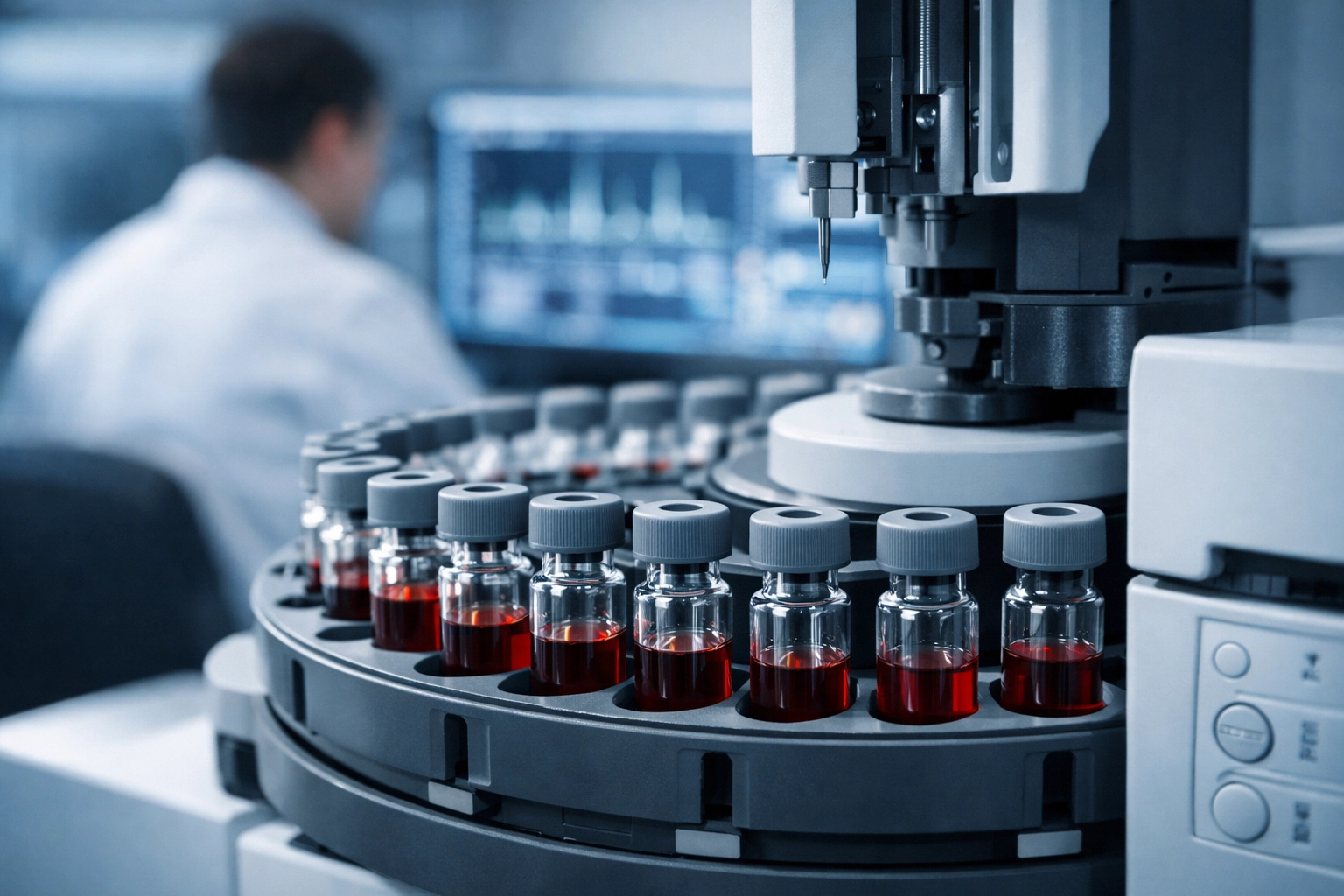
Texas laboratories use headspace gas chromatography: the sample is heated in a sealed vial and the vapor above the liquid is measured. The method is well established and reliable when run correctly.
"When run correctly" is where the defense work lives. Instruments require calibration, and runs require blanks and control standards to confirm the instrument reads what it should. We request the calibration and maintenance records, the run sequence, the chromatograms, and the analyst's notes. Carryover between samples in a run is a recognized concern in the discipline, which is exactly why blanks exist — and whether they were run, and what they showed, is a documented fact rather than a theory.
For more on the technical side of defense work, see our other criminal defense articles.
5. Chain of Custody — Weight, Not Automatic Exclusion
From the moment the needle leaves your arm until the analyst runs the sample, the specimen has to be accounted for. That record is the chain of custody.
Here is the correction that matters, because a great deal of DWI writing gets it wrong: in Texas, gaps in the chain of custody generally go to the weight of the evidence rather than its admissibility. Absent affirmative evidence of tampering or commingling, a gap does not automatically keep the result out. What it does is give the defense a real argument to a jury about whether the State can actually prove the sample tested was the sample taken — and that argument can be persuasive. But telling a client a documentation gap means the evidence will be thrown out sets an expectation the law does not support.
Hospital Blood vs. Forensic Blood
If a crash sent you to the hospital, the State may seek your medical records. Hospital testing is done for treatment, not for forensic purposes, and the two are not interchangeable.
The most important difference is what gets tested. Hospitals commonly analyze blood serum or plasma, while the Texas legal standard of 0.08 is defined in terms of whole blood. Serum contains proportionally more water than whole blood, so a serum value will generally read higher than the corresponding whole-blood value, and a conversion is required before the number means anything legally. The conversion ratio is a matter for expert testimony in the individual case rather than a fixed figure. If a prosecutor presents an unconverted hospital serum number as though it were a whole-blood result, that is a serious problem with their evidence. If your case also involves a collision, our resources on car accidents cover the civil side.
Frequently Asked Questions
Can I challenge a blood test if I signed the consent form?
Sometimes. Consent must be voluntary. The statutory warnings an officer is required to give under § 724.015 do not make consent involuntary — but extra-statutory warnings, meaning threats or promises not found in the law, can. The analysis turns on what was actually said, which is usually captured on video.
How long does the State have to test my blood?
There is no fixed expiration date. What matters is how the sample was preserved and stored in the interval, and whether the records show conditions that could have affected it. A long delay is a reason to examine the storage documentation closely, not a defense by itself.
Who is allowed to draw blood in a Texas DWI case?
Under Tex. Transp. Code § 724.017, only a physician, a qualified technician, a registered professional nurse, a licensed vocational nurse, or a licensed or certified EMT-intermediate or paramedic authorized under that section — and the draw must occur in a sanitary place. Nurses ordinarily qualify. What still gets verified is whether forensic protocol, which differs from routine clinical practice, was actually followed.
Can police force me to give blood?
This is widely misunderstood. Chapter 724 lists mandatory-draw circumstances — including crashes involving death or serious bodily injury — in § 724.012(a-1) and (b). But those provisions are not themselves a Fourth Amendment exception. In State v. Villarreal, 475 S.W.3d 784 (Tex. Crim. App. 2014), the Court of Criminal Appeals held that the implied-consent and mandatory-draw scheme does not by itself justify a warrantless, nonconsensual blood draw. Section 724.012(e) now states the requirement directly: an officer may not require a specimen without a warrant or probable cause to believe exigent circumstances exist. A forced draw with neither is a suppression issue.
Talk to a Houston DWI Lawyer
Defending a blood case is documentary work. The State has an institutional laboratory behind it; the answer is not rhetoric about junk science but a careful reading of the records that lab produced in your case.
Christopher Demerson and The Demerson Firm, PLLC request the calibration and maintenance records, the chromatograms and run data, the storage and transport logs, and the draw documentation — then examine the analyst on what those records show. Some cases have real problems. Some do not, and knowing which is which early is worth more than optimism.

If you are facing a DWI charge in Houston or the surrounding counties, the records have a retention schedule and the ALR clock is already running.
Call (346) 344-2007 or visit demersonlegal.com. The Demerson Firm, PLLC, 8323 SW Freeway, Ste. 415, Houston, TX 77074. We handle DWI matters in Harris, Fort Bend, Montgomery, Brazoria, and Galveston Counties.
This article is provided for general informational purposes only and is not legal advice. Reading it does not create an attorney-client relationship with The Demerson Firm, PLLC. Texas law changes, and whether any of the issues described here exist in a particular case depends entirely on that case's records and facts. If you have been arrested, speak with a licensed Texas attorney promptly.
Comments