
What If the Insurance Company Says You Were at Fault After a Houston Car Accident?

Updated: Sep 4
The moment following a car accident in Houston is often defined by a haze of adrenaline and confusion. However, the true conflict frequently begins days later when you receive a call from an insurance adjuster. When that adjuster informs you — casually or firmly — that their investigation has determined you are at fault for the collision, the stakes of your recovery change instantly.
In the legal landscape of Texas, an allegation of fault is not a mere difference of opinion; it is a calculated financial maneuver designed to trigger specific statutory bars to compensation. At The Demerson Firm, PLLC, we recognize that insurance companies are profit-driven entities. Their determination of liability is not a judicial verdict — it is a preliminary opening gambit. Understanding how to navigate this challenge requires a blend of legal precision, aggressive investigation, and a deep familiarity with Texas comparative negligence standards.
The Financial Incentive Behind the "At-Fault" Label
It is a fundamental mistake to view an insurance company as a neutral arbiter of truth. From the perspective of a multi-billion-dollar carrier, every claim represents a potential loss to their bottom line. By shifting the burden of fault onto you, the claimant, they achieve two primary objectives:
Reduction of Payouts: Under Texas law, if you are found partially responsible, your total compensation is reduced by your percentage of fault.
Total Claim Denial: A carrier's fault percentage is not a legal ruling — only a judge or jury assigns responsibility. But if the insurer can build a record that you bear more than 50% of the responsibility, Texas law would bar your recovery entirely, so pushing your share past that line is worth the whole claim to them.
This is why adjusters are trained to listen for "admissions against interest." A simple phrase like "I didn't see him coming" or "I’m so sorry this happened" can be weaponized in a claims report to justify a liability denial.

Common Mistakes That Compromise Your Liability Defense
Many Houston drivers inadvertently sabotage their own cases before they even consult an attorney. If you find yourself being blamed for an accident, evaluate whether you have fallen into these common traps:
Giving a Recorded Statement Without Representation
The "friendly" insurance adjuster often asks for a recorded statement to "get your side of the story." In reality, this is a structured interrogation. They use leading questions to lock you into a narrative that may be incomplete or technically inaccurate. Once recorded, these statements are difficult to walk back and serve as the cornerstone of their fault determination.
Relying Solely on the Police Report
There is a prevailing myth that the police report is the final word on fault. In Texas, officers usually do not witness the crash; they arrive afterward and assemble a narrative from statements and visible debris. A crash report is hearsay, but that is not the end of the analysis. Under Texas Rule of Evidence 803(8), a public record may be admitted where it sets out factual findings from a legally authorized investigation in a civil case, unless the opponent shows that the source of information or the circumstances indicate a lack of trustworthiness. In practice, courts often let in the objective portions of a report while excluding an officer's opinion on who was at fault and statements bystanders gave the officer, which are hearsay within hearsay. Admissibility is litigated case by case — an unfavorable report is not the end of your claim, and a favorable one is not a guarantee.
Failing to Secure Immediate Evidence
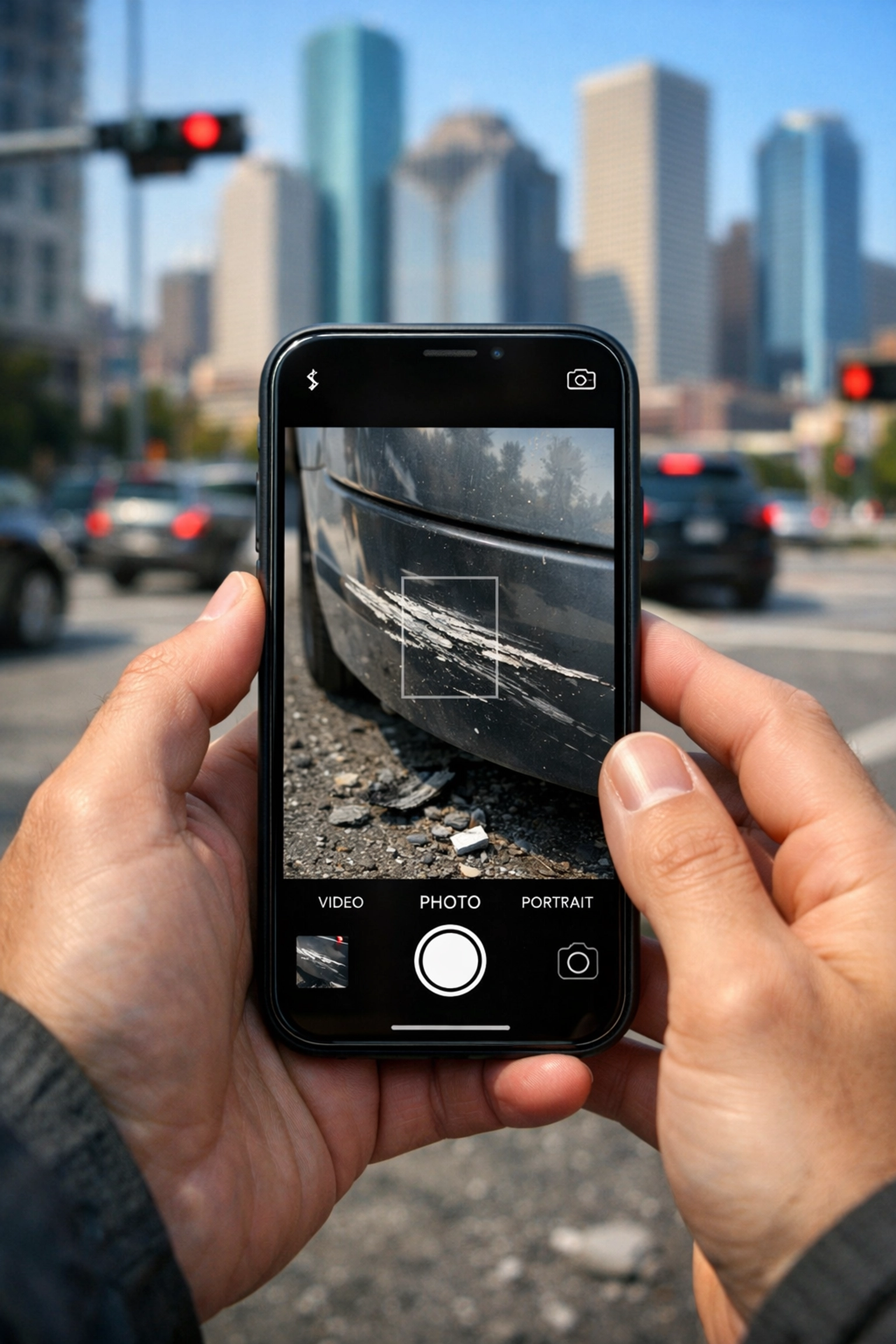
In the sprawling intersections of Houston, evidence disappears quickly. Skid marks fade, traffic camera footage is overwritten, and witnesses move on. If you do not have a rigorous collection of photos, video, and witness contact information, the insurance company fills that evidentiary void with assumptions that favor their insured driver.
Understanding Texas Modified Comparative Negligence
To fight back effectively, you must understand the legal framework of personal injury law in Texas. Texas follows a modified comparative negligence rule, commonly called the "51% bar."
Under Texas Civil Practice and Remedies Code Section 33.001, a claimant may not recover damages if his or her percentage of responsibility is greater than 50%. This creates a high-stakes environment where a shift of just 2% or 3% in fault can mean the difference between a six-figure settlement and zero recovery.
If you are found 20% at fault on a $100,000 loss (perhaps for a minor speeding infraction or failing to take evasive action), the court reduces your recovery by that percentage, to $80,000. Tex. Civ. Prac. & Rem. Code § 33.012(a). The insurance company's goal is always to push the needle past the 50% threshold, where the reduction becomes a complete bar.
How to Contest a Wrongful Fault Determination
When The Demerson Firm, PLLC takes on a contested liability case, we do not simply accept the insurance company’s findings. We launch an independent, intellectually rigorous investigation to deconstruct their narrative.
1. Accident Reconstruction
In complex car accidents, we may retain forensic engineers to reconstruct the physics of the crash. Crush patterns, delta-v (change in velocity), and point-of-impact data can show that the other driver's account does not fit what the vehicles actually did.
2. Event Data Recorder (EDR) Analysis
Modern vehicles are equipped with "Black Boxes" that record speed, braking, and steering inputs in the seconds leading up to a collision. This objective data often contradicts the self-serving statements of the driver who caused the accident.
3. Canvassing for Surveillance and Witnesses
In a city as densely populated as Houston, many collisions are captured by private security cameras or doorbell cameras. Before suit is filed there is no subpoena power, so the first move is a prompt written preservation request to the owner. Where footage exists and the owner will not produce it voluntarily, filing suit — or a pre-suit deposition petition under Texas Rule of Civil Procedure 202 — opens the door to a subpoena. Many systems overwrite within days, which is why the first week matters more than any argument made later.

The Role of Professional Advocacy
Contesting liability is an uphill battle. Insurance companies have teams of lawyers and adjusters dedicated to protecting their assets. To level the playing field, you need a firm that approaches injury case reviews with meticulous attention to detail.
We scrutinize the other driver’s history, looking for patterns of negligence or distractions, such as cell phone usage at the time of impact. We also examine the scene for external factors the insurance company may have ignored, such as obstructed signage or malfunctioning traffic signals, which may shift liability away from you entirely.
Deadlines That Can End the Fight Before It Starts
However the liability dispute turns out, it is bounded by filing deadlines that do not care who was right. In Texas, suit for personal injury generally must be brought not later than two years after the day the cause of action accrues. Tex. Civ. Prac. & Rem. Code § 16.003(a). A claim for injury resulting in death runs two years from the date of death. § 16.003(b). Limitations are tolled while the injured person is under 18. § 16.001.
If a governmental unit may share the blame — a malfunctioning signal, obstructed signage, a city or TxDOT vehicle — the clock is far shorter. The Texas Tort Claims Act entitles a governmental unit to written notice of the claim not later than six months after the incident. Tex. Civ. Prac. & Rem. Code § 101.101(a). Section 101.101(b) ratifies shorter periods set by a city charter, and the City of Houston's charter (Art. IX, § 11) requires written, verified notice within 90 days. That window can close months before you have finished arguing with an adjuster.

Frequently Asked Questions
Can I still win my case if the police officer gave me a ticket?
Yes. A traffic citation is an officer's opinion of a code violation; it is not a final determination of civil liability. In many cases, the citation may even be excluded from trial, and we can demonstrate that the other party’s negligence was the "proximate cause" of the accident regardless of the ticket.
What if the other driver changed their story later?
This is remarkably common. Initially, a driver might apologize, but after speaking with their insurer, they claim you cut them off. We use inconsistencies in their statements, combined with physical evidence, to impeach their credibility.
Should I hire a lawyer even if the insurance company says I'm 100% at fault?
Often it is still worth a look. A carrier's liability decision is an internal claims determination, not a legal ruling, and it can change when evidence the insurer did not have — or chose not to weigh — is put in front of it. Every case turns on its own facts, and prior results do not guarantee or predict the outcome of any other matter. What is certain is that the party who owes you money should not be the one who decides the question.
Take Decisive Action with The Demerson Firm, PLLC
If you are facing a liability dispute in Houston, time is your greatest enemy. The longer you wait to contest a fault determination, the more "fixed" the insurance company's narrative becomes. You need a strategy that is as disciplined as it is aggressive.
At The Demerson Firm, PLLC, we pride ourselves on providing authoritative legal counsel for those navigating the aftermath of serious collisions. Whether you were involved in a pedestrian accident or a complex multi-vehicle crash, we have the resources to fight back.
Do not let an insurance adjuster’s spreadsheet dictate your future. Secure a case strategy session today to discuss how we can test the carrier's version of events and pursue the compensation Texas law allows.

Contact The Demerson Firm, PLLC today for an accident consultation and let us begin the work of clearing your name and securing your recovery.
The Demerson Firm, PLLC · 8323 SW Freeway, Ste. 415, Houston, TX 77074 · (346) 344-2007 · chris.demerson@demersonlegal.com
This article is general information about Texas law. It is not legal advice, and reading it does not create an attorney-client relationship. Every case turns on its own facts, and prior results do not guarantee a similar outcome in any other matter.
Comments